Making New Jersey’s cancer map more accessible
New Jersey State Cancer Registry
GreenInfo team: Gregor Allensworth, Stephen Smith, Tim Sinnott
Project years: 2026
Tags: Accessibility Cartography Interactive Solutions Public Health Web Mapping
Overview
What challenges is this project trying to solve?
- Making a visual tool accessible to more people. The application needed better support for people with low vision, screen reader users, and keyboard navigation, along with alternatives to maps and charts.
- Clarifying a complex interface. Data filters and map display settings were grouped together, making it difficult to distinguish controls that changed the statistics from those that changed the map’s appearance.
- Updating an established platform. New Jersey had adapted GreenInfo’s open-source mapping template over several years. The refresh needed to address accessibility and usability while incorporating updated data and additional measures.
What were the client’s objectives?
- Improve accessibility throughout the application. Strengthen visual contrast, keyboard navigation, screen reader support, and the underlying structure of headings, forms, buttons, and tabs.
- Provide alternatives to visual displays. Allow visitors to access mapped statistics and chart data through readable, accessible tables.
- Make the interface easier to understand. Reorganize controls, clarify labels and instructions, and incorporate feedback from the registry team.
- Expand the available information. Incorporate updated cancer and demographic datasets, additional demographic measures, and metrics on late-stage cancer diagnoses.
Results
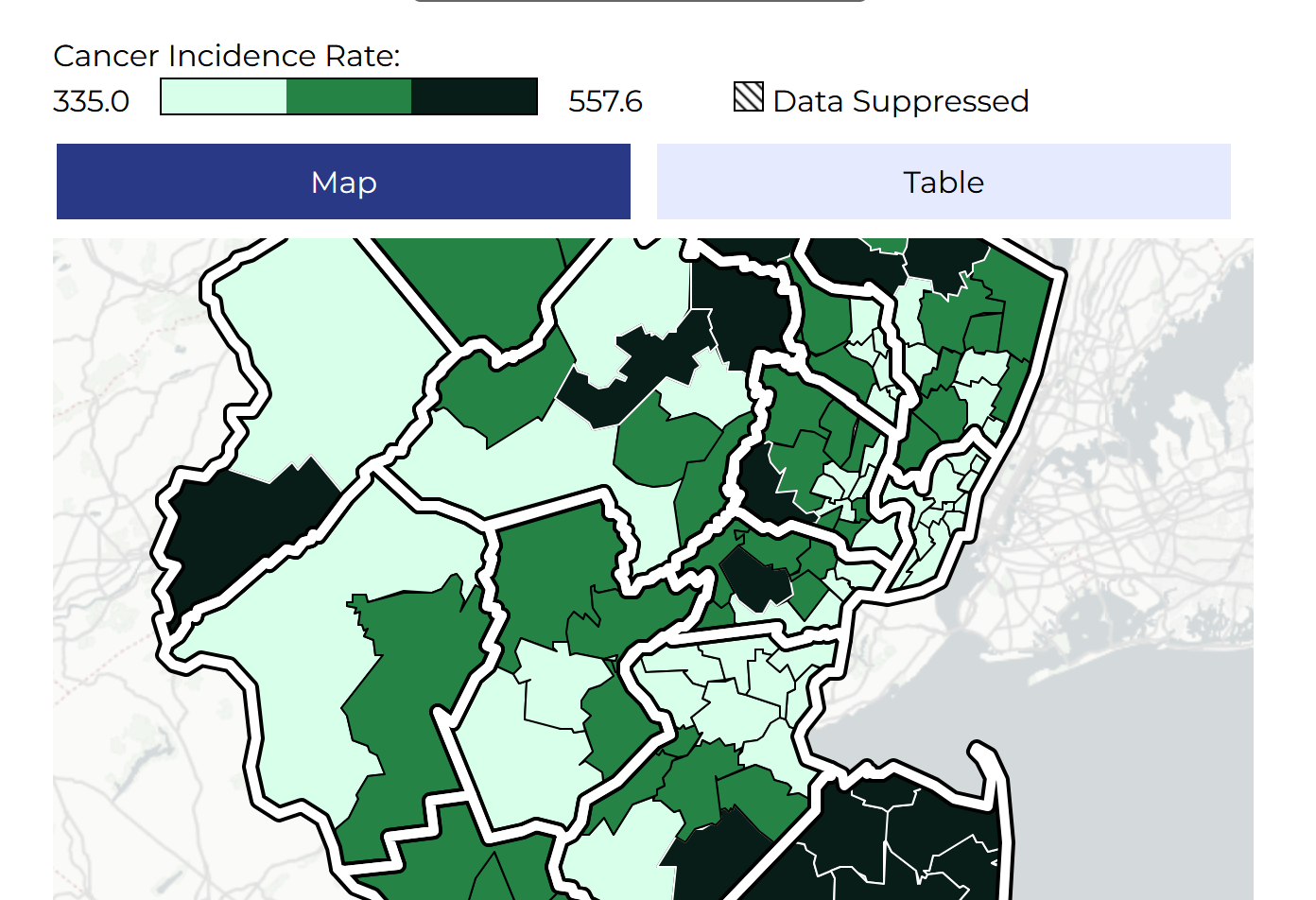
- New ways to explore the data. A table view makes mapped statistics available without relying on the map, and a companion table provides the numbers behind the age-adjusted incidence rate charts.
- A clearer, higher-contrast map. The default palette uses three colors with stronger contrast, while retaining a five-color option. Adjusted boundary colors help distinguish neighboring areas, and improved keyboard behavior supports navigation.
- More intuitive controls. Data filters are separated from map display settings, and an explicit Update Data button makes it clearer when selections are applied.
- Improved readability and assistive technology support. Darker interface colors, increased line spacing, and consistent text sizes complement improvements to form labels, buttons, tabs, and table structure.
- Expanded statistics and clearer explanations. Updated datasets and new measures broaden what visitors can explore, while revised text explains why we withhold some statistics to protect confidentiality and avoid reporting unstable rates.
The Work
Public health data is most useful when people can find, explore, and understand it. For an interactive map, that means considering how people navigate with a keyboard, interpret colors, use a screen reader, or access the numbers behind a visualization.
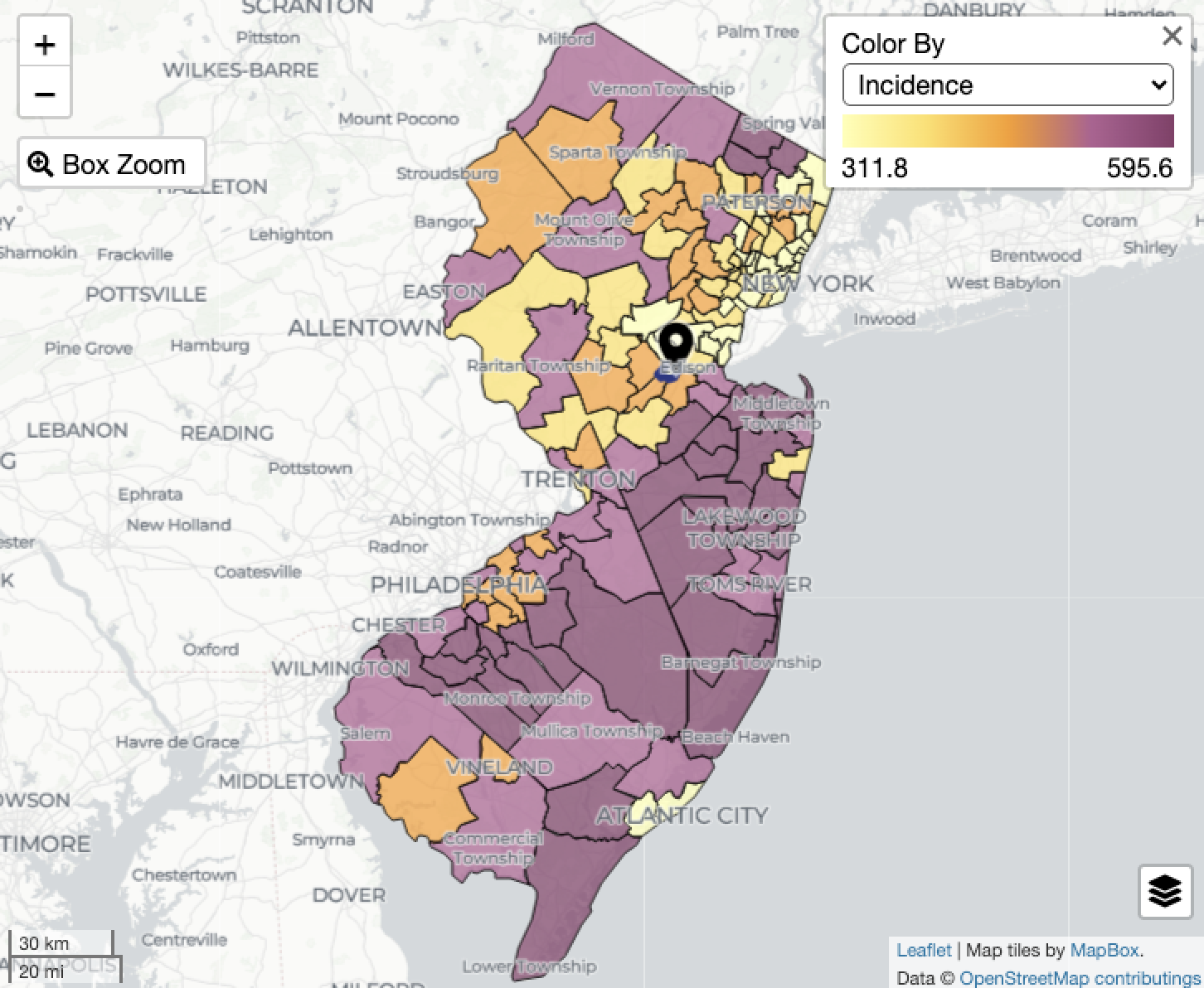
In 2026, GreenInfo Network worked with the New Jersey State Cancer Registry to improve the accessibility and usability of its Interactive Cancer Map. The project paired an accessibility-focused refresh with updated data and new ways to explore cancer and demographic statistics.
Project Background
The project grew out of a challenge familiar to public health practitioners: county-level statistics can obscure important differences within communities. Researchers at UCSF, working with the National Cancer Institute, developed reporting areas called “aggregation zones” to make more local cancer statistics available while protecting confidentiality and supporting reliable estimates.
GreenInfo helped bring that work to the public through California Health Maps. We then worked with Westat and UCSF to turn the application into an open-source template that other state cancer registries could adapt.
New Jersey was among the states that adopted the platform. When its team wanted to improve accessibility and expand the application’s capabilities, they returned to GreenInfo. The collaboration offered an opportunity to apply what we’ve learned over several years of accessible mapping work to an established public health resource.